
Insights
Solid Carbon Byproduct in Turquoise Hydrogen Production: Commercial Uses and Market Potential
One of the most distinctive aspects of turquoise hydrogen production is the generation of a solid carbon byproduct instead of carbon dioxide.
This fundamental difference has significant implications for both emissions reduction and industrial material markets.
While most discussions focus on hydrogen output, the solid carbon byproduct deserves equal attention.
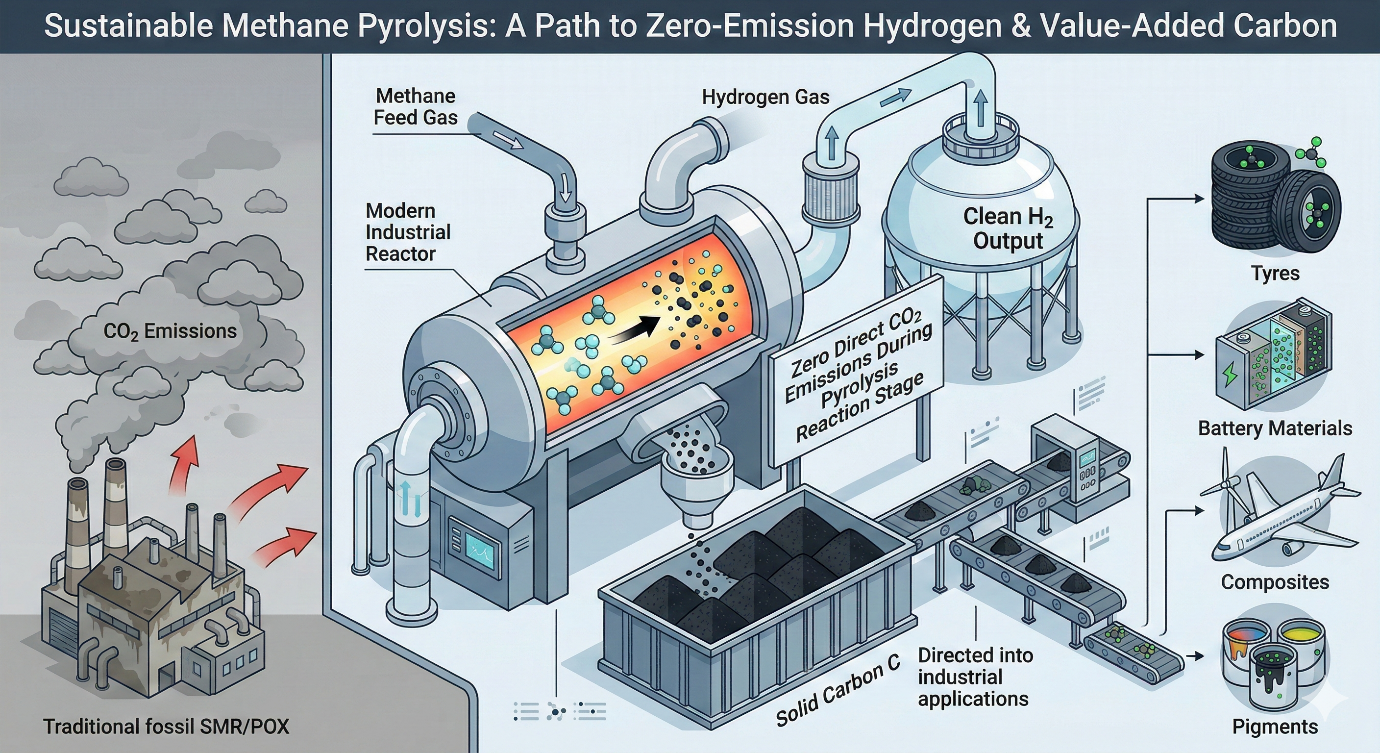
Why Solid Carbon Matters
Traditional fossil-based hydrogen production methods generate CO₂ as a gaseous emission. In contrast, methane pyrolysis hydrogen technology separates methane into:
- Hydrogen (H₂)
- Solid carbon (C)
This eliminates direct carbon dioxide emissions during the reaction stage and transforms carbon into a stable, solid form.
This shift from gaseous carbon emissions to solid carbon output introduces a potential secondary revenue stream if managed effectively.
Potential Commercial Applications
The carbon output from methane pyrolysis may have multiple industrial applications, depending on its purity, structure, and morphology.
Potential uses include:
- Carbon black alternative for tyres and rubber
- Conductive additives in battery materials
- Reinforcement materials used in composites
- Pigments and industrial fillers
- Advanced carbon materials research
The global carbon black market alone represents a substantial industrial demand base. If solid carbon from hydrogen production meets specification standards, it could displace fossil-derived carbon black in selected applications.
Quality and Processing Considerations
Not all solid carbon byproduct is immediately market-ready.
Commercial viability depends on:
- Carbon purity levels
- Particle size distribution
- Surface structure
- Post-processing requirements
Further refinement steps might be necessary before integration into industrial supply chains.
Producers working on methane pyrolysis technology need to consider both hydrogen production efficiency and effective downstream carbon management strategies.
Environmental Implications
From a lifecycle perspective, converting methane into hydrogen and stable carbon instead of CO₂ significantly alters emissions.
However, sustainability depends on:
- Responsible sourcing of methane
- Secure storage or utilisation of carbon.
- Preventing unintended combustion or re-emission
When managed properly, solid carbon storage is naturally more stable compared to carbon capture and storage (CCS) methods that handle gaseous CO₂.
Market Outlook for Hydrogen Solid Carbon
As turquoise hydrogen production increases, the total amount of solid carbon could become significant in global industrial markets.
The commercial opportunity depends on aligning:
- Hydrogen demand growth
- Carbon material markets
- Integrated value chain partnerships
The long-term competitiveness of methane pyrolysis hydrogen may ultimately depend not only on hydrogen pricing but also on how effectively the solid carbon byproduct is commercialised.
This secondary product could shift turquoise hydrogen from a decarbonisation solution to a dual-market industrial platform.